
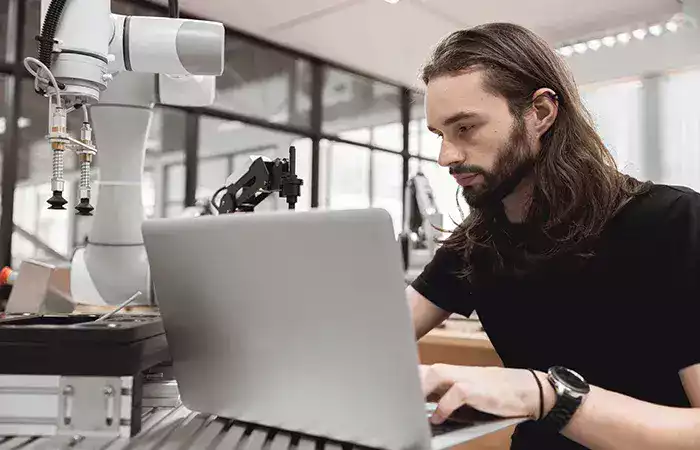
What Is Automation? The word “automation” once conjured images of assembly-line robots welding car frames in automotive factories. That narrow definition is now obsolete. Automation today encompasses software that processes invoices, artificial intelligence that writes code, and multi-agent systems that coordinate supply chains. It’s no longer just about replacing physical labor; it’s about augmenting and sometimes replacing cognitive work.
Globally, over 80,000 technology jobs were cut in the first quarter of 2026 alone, with nearly half directly linked to AI implementation and workflow automation News18 Report. Yet demand for AI engineers surged 245% year over year . These aren’t contradictory signals. They’re evidence of a fundamental restructuring of how work gets done.
Understanding what automation really is, how it’s evolving, and what it means for careers is essential knowledge for anyone navigating the modern workforce. Here’s what’s happening behind the headlines.
What Is Automation? From Fixed Rules to Intelligent Agents
At its core, automation is the use of technology to perform tasks with minimal human intervention. But the kind of automation matters enormously, and the technology has evolved through distinct generations.
Traditional automation, sometimes called robotic process automation or RPA, operates on fixed rules. It handles payroll processing, invoice data entry, and scheduled report generation. It works perfectly when inputs are predictable and exceptions are rare. The limitation is equally clear: rule-based automation breaks when it encounters scenarios it wasn’t explicitly programmed to handle.
The current wave is different. AI-powered automation combines machine learning, natural language processing, and computer vision to handle tasks that require judgment. It doesn’t just follow instructions. It interprets context, makes decisions within defined guardrails, and learns from outcomes. A customer service AI agent doesn’t just match keywords to scripted responses. It understands the customer’s intent, checks order status across multiple systems, and determines whether a refund is warranted based on company policy and the customer’s history.
Many enterprises are now moving toward multi-agent systems—networks of specialized AI agents that collaborate on complex workflows. One agent might analyze an insurance claim, another verifies compliance, a third flags anomalies for human review, and a fourth generates the decision rationale for audit purposes. These systems operate autonomously but within governed boundaries, with humans stepping in only when risk thresholds are breached.
Where the Jobs Are Changing: An Uneven Transformation
The impact of automation on employment is not distributed evenly. It follows a pattern that’s becoming clearer as data accumulates.
Entry-level white-collar roles are experiencing the most significant contraction. Data entry clerks, junior software developers, quality assurance testers, and basic accounting positions are declining sharply, with some categories seeing reductions of 45% to 75%. These roles share a common vulnerability: they involve routine, rules-based tasks that AI can now perform faster and at scale. Entry-level job postings across major economies have dropped significantly over the past 18 months, and companies report reducing junior hiring as AI adoption scales.
At the same time, new roles are emerging at a rapid pace. AI engineers and machine learning specialists are the fastest-growing category, with demand surging by triple-digit percentages. Cybersecurity specialists, cloud architects, and data analysts who can translate AI outputs into business insights are seeing sustained growth . What’s particularly notable is the emergence of hybrid roles that didn’t exist a few years ago—positions like telehealth coordinators, learning experience designers, and customer experience designers that combine technical fluency with human judgment and creativity .
Blue-collar and skilled trade roles are demonstrating unexpected resilience. Construction workers, electricians, logistics operators, and maintenance professionals operate in environments that require physical presence, contextual awareness, and real-time adaptation. AI can assist these workers—providing augmented reality overlays with repair instructions, for instance—but cannot replace them at scale . This has contributed to a notable shift in career preferences, with a growing number of younger workers opting for vocational training and trade careers that offer faster employability and reduced exposure to automation.
The key distinction isn’t between “blue-collar” and “white-collar” work. It’s between routine tasks that can be codified and non-routine tasks that require physical dexterity, emotional intelligence, creative problem-solving, or complex judgment. Routine work, whether performed in a factory or on a spreadsheet, faces automation pressure. Non-routine work, regardless of collar color, remains stubbornly human.
The Real Numbers: Layoffs, Creation, and Net Effects
The relationship between automation and employment is more nuanced than “robots are taking all the jobs” or “AI will create more jobs than it destroys.”
The layoff data from early 2026 is sobering. In the first quarter alone, global technology companies cut 78,557 positions, with the United States accounting for nearly 77% of those losses . Cloud computing and software companies led the reductions with approximately 28,000 job cuts, followed by e-commerce with 19,000 e-commerce with 19,000. Major firms including Oracle, Amazon, and Meta have all conducted significant restructurings tied explicitly to automation investment and AI infrastructure expansion.
However, a significant portion of these cuts appear to be pre-emptive cost reduction and organizational restructuring rather than direct task-level replacement task-level replacement . Some executives may be using AI as a justification for financial adjustments that would have happened regardless happened regardless. The true productivity impact of current AI implementations will likely become clearer over the next six to twelve months.
On the creation side, the evidence suggests that while AI is displacing some roles, it’s also generating demand for new ones. Current surveys and labor data indicate short-term net job gains with shifts toward AI-related positions rather than economy-wide displacement. The transformation is real, but it currently appears to be reshaping the composition of the workforce rather than reducing its overall size .
The structural concern is about job quality, not just quantity. Mid-level positions are declining while part-time and contract work increases, suggesting a hollowing out of stable career paths even as total employment figures hold steady . The entry-level rungs on many corporate ladders are weakening, raising questions about how future professionals will gain the experience needed for senior roles.
Beyond Job Numbers: How Work Itself Is Changing
The more profound transformation may be in how work is organized and performed, regardless of employment levels.
Work is becoming increasingly asynchronous. The traditional 9-to-5 workday is fragmenting as employees optimize schedules around personal productivity and global team coordination. Data traffic no longer peaks neatly during business hours but spreads across a 12-to-14-hour window. This shift has implications for infrastructure, management practices, and employee well-being that organizations are only beginning to address.
AI agents are becoming active participants in workflows, not just tools. By 2026, it has become normal for employees to rely on multiple AI agents throughout the day—some writing code, others summarizing meetings, moving data between systems, or monitoring performance metrics . These agents often operate continuously, outside human working hours, executing tasks autonomously.
This introduces governance challenges that many organizations have not fully confronted. AI agents can become privileged users with access to sensitive systems, often without the same scrutiny applied to human employees. Shadow AI usage expands as employees adopt tools outside formal IT approval processes. Automated activity blurs accountability, making it harder to trace errors or security incidents .
The automation of physical work is also advancing, though at a more measured pace. Cumulative installed capacity of industrial robots is projected to surpass 5.5 million units globally by 2026. Drones are gaining autonomous navigation and obstacle avoidance capabilities. Humanoid robots are advancing from pre-programmed tasks toward contextual understanding and autonomous decision-making decision-making. The fully autonomous factory remains a vision for the 2030s, but the building blocks are being assembled now.
The Skills That Matter: What Workers Need to Know
In an automating world, certain skills increase in value while others depreciate.
Technical skills related to AI development, deployment, and oversight are in obvious demand. AI engineering, machine learning operations, cybersecurity, and cloud architecture roles are growing rapidly and commanding salary premiums. Companies report that skilled AI engineers saw salary increases of nearly 19% in 2025 while demand continued to outstrip supply .
But the emphasis on purely technical skills misses half the picture. As routine cognitive tasks get automated, human capabilities become more valuable, not less. Leadership, creativity, complex communication, judgment under uncertainty, and emotional intelligence are precisely the skills that automation cannot replicate. The most resilient careers combine technical fluency with these deeply human capabilities.
The concept of “hybrid skills” has emerged as the dominant framework for career resilience. Employees need AI literacy, data fluency, and comfort with automation tools, but they also need to develop capabilities that distinguish human workers from automated systems. A financial analyst who can prompt AI to generate reports and interpret those reports for clients in the context of their life goals is far more valuable than one who can only generate reports or only build relationships.
Organizations face a parallel challenge. As entry-level roles decline, traditional talent pipelines weaken. Companies lose the junior positions that historically fed their mid-level and senior ranks, creating gaps in future leadership development. Workforce strategies must account not just for current automation capabilities but for the long-term health of talent development pathways. Some industry leaders are calling for increased investment in training recent graduates on AI tools to bridge the emerging skills gap .
Conclusion: Automation Is a Mirror
Automation is not an external force that happens to the workforce. It’s a reflection of choices made by organizations, policymakers, and individuals. The technology itself is neutral. Whether it primarily displaces workers or augments them, widens inequality or creates new paths to prosperity, depends on how it’s governed and who gets to participate in shaping it.
The data from 2026 shows a labor market in transition, not collapse. Jobs are being eliminated and created simultaneously. The net effect so far is transformation rather than reduction in total employment, but the quality, accessibility, and career trajectory of those jobs are shifting in ways that demand attention.
For individual workers, the most practical strategy is not to race AI at tasks it excels at but to develop capabilities that complement it. Technical literacy with AI tools. Judgment in ambiguous situations. Creativity in problem formulation. Empathy in human interaction. These skills become more valuable as automation handles the routine.
For organizations, the challenge is governance. Agentic AI systems need guardrails, audit trails, and clear accountability frameworks. The companies that succeed will treat automation not as a cost-cutting tool but as an operating model that requires new approaches to oversight, talent development, and organizational design.
Automation is changing work. It always has. The question is whether we shape that change or simply react to it.