

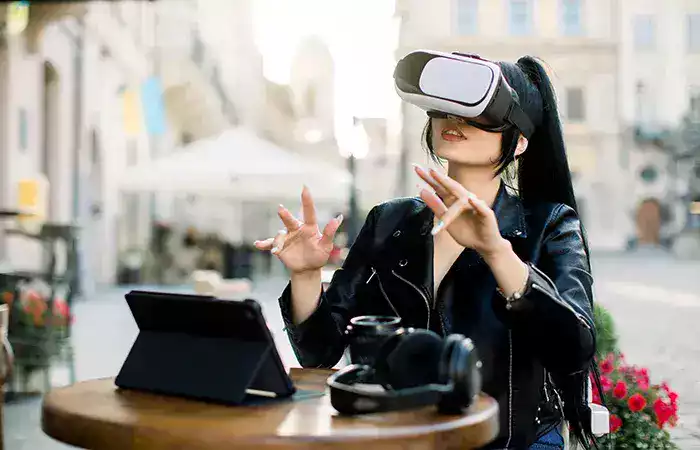
This guide explains augmented reality vs virtual reality in simple terms — no technical background required. Whether you are a student, professional, or just curious, you will understand the key differences in under 10 minutes.
We live in an era where the line between the digital world and the physical world is blurring faster than ever. You’ve probably heard the terms Augmented Reality (AR) and Virtual Reality (VR) thrown around in conversations about gaming, the metaverse, or even online shopping. But if you aren’t a tech enthusiast, the distinction might feel murky. You might find yourself asking: Are they the same thing? Do I need a headset for both? And most importantly, why should I care?
Understanding the difference between AR and VR isn’t just for Silicon Valley programmers anymore. These technologies are reshaping healthcare, education, marketing, and how we connect with one another. This guide breaks down the complicated jargon and explains what is augmented reality vs virtual reality in the simplest terms possible, giving you a clear picture of how they work, how they differ, and where they are headed.
The Core Concept: Perception vs. Immersion
To grasp the difference instantly, think of it as a spectrum of reality.
Virtual Reality (VR) is a complete escape. It shuts out the physical world and transports you to a fully digital environment. When you put on a VR headset, you aren’t in your living room anymore; you are standing on the surface of Mars, exploring the bottom of the ocean, or fighting zombies in a post-apocalyptic city. The keyword here is immersion.
Augmented Reality (AR) is an overlay. Instead of replacing your vision, it adds digital layers to the real world around you. You remain completely present in your physical environment, but computer-generated images, text, or sounds enhance what you see and hear. The keyword here is enhancement.
A simple analogy is the difference between going to a movie theater and wearing smart glasses. In a theater (VR), the lights go out, and you are absorbed by the screen, detached from your seat. With smart glasses (AR), you still see the world walking by, but a digital weather report or directional arrow floats gently in the corner of your vision. For AR to place that arrow correctly, the device must recognize real-world surfaces and objects — a job powered by artificial intelligence explained in our guide.
Diving Deep: What is Virtual Reality (VR)?
Virtual Reality is a computer-generated simulation of a three-dimensional environment that can be interacted with in a seemingly real or physical way by a person using special electronic equipment. To achieve this, VR relies almost exclusively on head-mounted displays (HMDs) that block out your natural field of view.
How VR Technology Works
The magic of VR lies in a field called “computer vision” and high-speed tracking. Inside a modern VR headset like the Meta Quest 3, HTC Vive, or PlayStation VR2, there are screens placed just inches from your eyes. Lenses reshape these flat images into a stereoscopic 3D view, giving you depth perception.
But immersion isn’t just visual. A core component of VR is six degrees of freedom (6DoF) . This means the headset tracks your head’s movement—not just turning your head left or right, but physically ducking, leaning forward, or stepping sideways. External sensors or built-in cameras translate your real-world body movements into the virtual space instantly, part of the same web of sensors behind the Internet of Things. When you bend down to pick up a virtual object, your digital avatar does the same. Add in spatial audio and haptic feedback controllers, and your brain starts to accept the simulation as reality—a phenomenon called presence.
Best Use Cases for Virtual Reality
While gaming is the most famous application, VR has evolved far beyond entertainment:
-
Training and Simulation: Pilots, surgeons, and even firefighters use VR to practice high-stakes scenarios without real-world danger. A surgeon can rehearse a complex heart surgery dozens of times before touching a patient.
-
Mental Health Therapy: VR is revolutionizing exposure therapy. A patient with a fear of heights can stand on a virtual skyscraper ledge, knowing they are perfectly safe, gradually reducing their anxiety.
-
Virtual Tourism and Real Estate: Why fly across the country to view a house when you can walk through it with perfect scale perception from your couch?
Diving Deep: What is Augmented Reality (AR)?
Unlike VR’s heavy hardware, Augmented Reality is surprisingly accessible. In fact, you probably have the world’s most popular AR platform in your pocket right now: your smartphone camera — and our guide on how smartphones work shows the sensors that make it possible.
AR technology overlays digital information—images, 3D models, text, or filters—onto the real world in real-time. It does not create the world; it “augments” it. The defining characteristic of AR is that you can still see, touch, and interact with your actual surroundings.
How AR Technology Works
AR technology relies on a combination of cameras, sensors, and processors to understand the physical space. Here are the key mechanisms:
-
SLAM (Simultaneous Localization and Mapping): This is the backbone of modern AR. As you point your phone’s camera at a surface, the SLAM algorithm maps the environment while simultaneously tracking your device’s position relative to it. This allows a digital Pokemon character to “stand” on a park bench without sliding off.
-
Marker-Based vs. Markerless AR: Marker-based AR triggers a digital overlay when the camera sees a specific physical image, like a QR code or a movie poster. Markerless AR, which is more complex, uses GPS, accelerometers, and digital compasses to place objects anywhere in the open world without a trigger image.
-
Projection and Displays: While phone-based AR is common, the future lies in transparent wearable glasses (like the rumored Apple Vision Pro’s passthrough capability or the Xreal Air). These devices project light onto a clear lens, creating holographic images that coexist with your natural vision.
Best Use Cases for Augmented Reality
AR thrives in utility—making your daily life easier without removing you from it:
-
Retail and “Try Before You Buy”: IKEA Place lets you drop a true-to-scale virtual sofa into your living room to check the fit and color. Warby Parker lets you try on glasses from your couch. This drastically reduces return rates and purchase hesitation.
-
Navigation and Information: Instead of looking down at a 2D blue dot on a phone map, AR navigation (like Google Maps Live View) paints arrows onto the actual street seen through your camera. In a factory, technicians can look at a complex engine and see step-by-step repair instructions overlaid directly onto the parts.
-
Education and Design: Architects can place a 3D model of a skyscraper onto an empty dirt lot and walk around it, spotting design flaws before breaking ground. Medical students can study a beating 3D heart floating above their desk, spinning it and peeling back layers.
The Great Comparison: Head-to-Head Differences
While both are spatial computing technologies, they solve different problems. To make this crystal clear, let’s put them side-by-side.
| Feature | Augmented Reality (AR) | Virtual Reality (VR) |
|---|---|---|
| Environment | Digital objects added to the real world. | User is completely isolated in a digital world. |
| Hardware | Smartphones, tablets, AR Glasses (Smart Glasses). | Tethered headsets (PC/Console) or standalone headsets (Meta Quest). |
| Awareness | User remains fully aware of their physical surroundings. | User is visually and audibly blocked from the physical world. |
| Bandwidth Needs | Lower; relies on local processing and small data overlays. | Extremely high; requires streaming massive 3D environments, often 4K per eye. |
| Risk Factor | Low risk; you can see where you are walking. | “VR Hangover”; motion sickness, tripping over furniture, wall collisions. |
| Primary Goal | Utility, information, and convenience. | Immersion, escapism, and intense simulation. |
The Blended Future: Mixed Reality (MR)
No discussion about AR vs. VR is complete without mentioning Mixed Reality (MR) . Often described as the best of both worlds, MR is a superset of AR. It doesn’t just overlay static images onto the world; it anchors them there and allows you to interact with them.
Imagine wearing a headset where you see your real living room, but a virtual portal opens on your wall, and aliens crawl out from behind your real couch, respecting the physical boundaries of your coffee table. That’s Mixed Reality. The digital and physical objects not only co-exist but interact. The digital coffee cup sits on your real wooden table, and if you push the table, the cup moves with it. Apple’s entrance into the market with the Apple Vision Pro is a massive bet on MR, or what they call “spatial computing,” where the line between AR and VR dissolves depending on a digital crown that lets you dial in your level of immersion.
Which Technology Is Winning? (And Why It Matters for You)
The question “What is augmented reality vs virtual reality” isn’t about which one is better; it’s about which tool is right for the job.
If your goal is to disconnect from a stressful commute and enter a completely calm, virtual meditation beach, VR is the superior choice. If your goal is to fix a complex piece of machinery where you need your hands and eyes free but want a digital manual floating in your peripheral vision, AR is unbeatable.
From a business perspective, AR currently commands a larger total addressable market simply because it lives in the billions of smartphones already in circulation. Snapchat filters, TikTok effects, and Google Lens have already introduced the masses to rudimentary AR without them even realizing it. However, VR is carving out a massive niche in hardcore gaming, high-fidelity training, and the emerging “metaverse” social hubs where people gather as avatars.
The Challenge of Hardware and Comfort
The future success of both hinges on hardware miniaturization. Nobody wants to walk down the street looking like a cyborg. For AR, the holy grail is a pair of spectacles that look identical to Ray-Bans but display high-definition 3D holograms. We are getting close with devices like the Meta Ray-Ban smart glasses, though they currently lack visual AR displays. For VR, the race is to shrink the bulky ski-mask design into something more like sleek goggles while eliminating the nausea caused by the “vergence-accommodation conflict”—a visual mismatch where your eyes focus on a flat screen even though you perceive a 3D world depth.
Conclusion
So, what is augmented reality vs virtual reality? In the simplest explanation: Virtual Reality takes you somewhere else, while Augmented Reality brings something to you. VR is a stunt double that swaps you out of reality; AR is an invisible assistant that paints helpful hints over your existing life.
As these technologies mature, the rivalry between them will fade. The winner will be the company that seamlessly merges the AR and VR experience into a single, lightweight device that you can wear all day. We are moving toward a world where “reality” is just a volume dial. You can turn it down with VR to escape completely, or turn it up with AR to become a supercharged version of yourself. Whether you are a consumer, an investor, or just curious, understanding this difference now is crucial, because the hardware you wear on your face in ten years will likely be the successor to both the smartphone in your pocket and the monitor on your desk.



0 Comments