

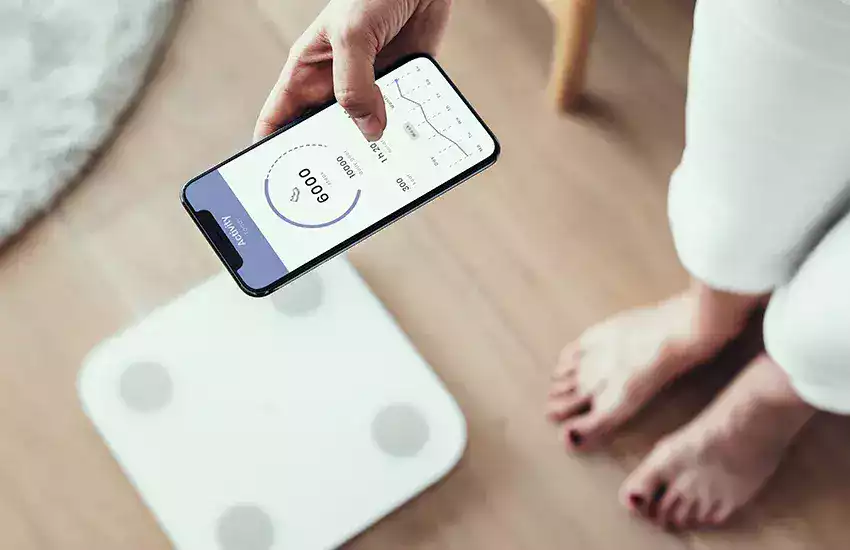
The bathroom scale has been a simple device for over a century. You step on. A dial spins or a number appears. You see your weight. You step off. That was it. No context. No trends. No information about what that number actually means. Just a single data point that often caused more anxiety than insight.
Smart scales have changed everything. Today’s connected scales do not just measure weight. They estimate body fat percentage, muscle mass, bone density, water weight, and even metabolic rate. They sync automatically to your smartphone via Bluetooth or Wi-Fi. They track trends over days, weeks, and months. They display graphs that show whether your weight is heading up or down, whether your muscle mass is increasing, and whether your body composition is shifting in a healthy direction.
But how do these devices actually work? A scale cannot reach inside your body and measure fat directly. It cannot weigh your muscles separately from your organs. The technology behind smart scales is clever but imperfect. Understanding how it works—and where it falls short—is essential for using the data safely and effectively.
A smart scale works best alongside wearable health devices that track the rest of your day.
As an SEO and health technology analyst who has tested over a dozen smart scales and interviewed biomedical engineers about their algorithms, I have seen the inner workings. A smart scale is one piece of what smart health is. The technology is fascinating. The marketing can be misleading. The real value is not in any single reading but in the long-term trend.
This article will explain how smart scales track weight and body metrics daily. You will learn about Bioelectrical Impedance Analysis (BIA), the core technology behind most smart scales. You will understand which metrics are reliable, which are estimates, and how to use the data to support your health goals — especially when tracking chronic conditions over time.
Part 1: The Core Technology — Bioelectrical Impedance Analysis (BIA)
Every smart scale that measures body composition beyond weight uses the same underlying technology: Bioelectrical Impedance Analysis (BIA). The name sounds complex, but the principle is straightforward.
How BIA Works
A smart scale has electrodes on its surface. Usually there are four metal pads: two under your feet and two under your toes. Some advanced scales also have a handheld component with additional electrodes, but foot-only scales are most common for home use.
When you step onto the scale, it sends an extremely low, safe electrical current through your body. The current is so weak—typically less than 1 microampere—that you cannot feel it. It is far below the threshold for any sensation or harm.
The current travels up one leg, through your pelvis and lower torso, and down the other leg. Importantly, foot-only scales measure only the lower half of your body. The current does not reach your arms, chest, or abdomen. This is a key limitation we will discuss later.
Different body tissues conduct electricity at different rates. Muscle tissue is about 70% water and contains electrolytes (sodium, potassium, chloride) that conduct electricity very well. Low resistance. Fat tissue contains much less water and conducts electricity poorly. High resistance. Bone and other tissues fall somewhere in between.
The scale measures the resistance (impedance) the current encounters as it travels through your body. From that single resistance measurement, combined with your height, weight, age, and sex, the scale’s algorithm estimates your body composition.
From Resistance to Body Fat Percentage
Here is the simplified formula: Lower resistance (current flows easily) suggests more muscle mass and less fat. Higher resistance suggests more fat mass and less muscle.
The scale takes your raw resistance measurement and plugs it into an equation developed from population studies. The equation estimates:
-
Total body water (because water conducts current)
-
Fat-free mass (muscle, bone, organs — all mostly water)
-
Fat mass (total weight minus fat-free mass)
-
Body fat percentage (fat mass divided by total weight)
The algorithm also estimates other metrics: muscle mass, bone mass, visceral fat (fat around your organs), metabolic rate, and protein mass. These are derived from the primary fat and water estimates using additional population-based formulas.
Why Age, Sex, and Height Matter
The same resistance measurement means different things for different people. A 25-year-old male athlete and a 65-year-old sedentary female have very different body compositions even if they have identical resistance readings.
Smart scales ask for your age, sex, and height during setup because these variables change the interpretation of the resistance signal. The algorithm applies different equations based on these inputs. This is why your scale asks for this information. Without it, the body fat estimate would be wildly inaccurate.
Part 2: What Smart Scales Measure — And How Reliable Each Metric Is
Not all metrics from your smart scale are equally reliable. Understanding which numbers to trust and which to treat with skepticism prevents unnecessary anxiety.
Weight (Highly Reliable)
Weight measurement is straightforward. A smart scale uses a load cell, the same technology as a traditional digital scale. It is accurate to within 0.1-0.2 pounds (about 50-100 grams) for quality scales.
Weight is also the most variable metric. Your weight fluctuates 2-5 pounds daily due to water retention, food intake, bowel contents, and hormonal cycles. This is normal. Do not panic at daily ups and downs. Look at the weekly average trend.
Body Fat Percentage (Moderately Reliable for Trends, Not Absolute)
The body fat percentage from a smart scale is an estimate, not a measurement. Compared to gold standard methods (DEXA scans, hydrostatic weighing, MRI), consumer BIA scales have an error range of approximately 3-5 percentage points.
If a DEXA scan says your body fat is 25%, your smart scale might report anywhere from 22% to 28%. That is a wide range. For individuals with atypical body shapes, very high or very low body fat, or certain medical conditions, the error can be larger.
However, consumer BIA is reasonably reliable for tracking changes over time. If your scale says 28% today and 26% three months from now, your body fat has likely decreased, even if the absolute numbers are not perfectly accurate. The direction of change is more meaningful than the specific number.
Critical limitation for foot-only scales: The current travels only through your lower body. The scale is actually measuring the composition of your legs and extrapolating to your whole body. If you carry fat differently than the average person used to develop the algorithm—for example, more fat in your abdomen or arms than your legs—the estimate will be off.
Muscle Mass (Moderately Reliable for Trends)
Muscle mass estimates are derived from fat-free mass. Like body fat percentage, the absolute number may not be accurate, but the trend is useful. If your muscle mass is trending upward over months while your weight is stable or slowly declining, you are likely gaining muscle and losing fat—a positive health outcome.
Water Weight (Low Reliability)
Total body water estimates are rough. BIA measures total body water reasonably well in research settings, but consumer scales use simplified algorithms. Dehydration, recent exercise, alcohol consumption, and menstrual cycle phase cause large, rapid changes in water weight that the scale cannot distinguish from changes in fat or muscle.
Do not put significant weight (pun intended) on daily water weight readings. Watch the trend over weeks.
Bone Mass (Very Low Reliability)
Consumer BIA cannot measure bone mass directly. Bone is estimated from population averages based on your weight, age, and sex. The “bone mass” number on your smart scale is essentially a guess. Ignore it. If you have bone health concerns, discuss DEXA scanning with your doctor.
Visceral Fat (Very Low Reliability)
Visceral fat is the fat stored around your abdominal organs. It is more dangerous for metabolic health than subcutaneous fat (fat under your skin). Consumer BIA cannot measure visceral fat directly. The “visceral fat” rating on your scale is a statistical estimate based on your overall body fat percentage and waist-to-hip ratio assumptions. Do not rely on it. Waist circumference measured with a tape measure is a better indicator.
Metabolic Rate (Low Reliability)
Your Basal Metabolic Rate (BMR) is the calories your body burns at complete rest. Smart scales estimate BMR from your fat-free mass using standard equations. The error margin is significant—typically 10-20%. If your scale says you burn 1,800 calories per day at rest, your true BMR could be anywhere from 1,500 to 2,100. Do not make eating decisions based solely on your scale’s BMR estimate.
Part 3: How to Use Your Smart Scale Correctly
The way you use your smart scale dramatically affects the quality of the data. Follow these protocols.
Consistency Is Everything
For meaningful trends, measure under identical conditions every time:
-
Same time of day. Measure first thing in the morning, after using the bathroom, before eating or drinking. This minimizes the impact of food, water, and daily activity fluctuations.
-
Same day of week (or daily with weekly averaging). If you weigh daily, look at the 7-day moving average, not the daily number. If daily weighing causes anxiety, weigh once per week on the same day (e.g., every Friday morning).
-
Same hydration status. BIA is highly sensitive to hydration. Being dehydrated increases resistance, making you appear fatter. Being overhydrated decreases resistance, making you appear leaner. Measure before drinking water in the morning for consistency.
-
Same position on the scale. Stand with your feet centered on the electrodes. Do not shift your weight. Do not lean on anything.
-
Same clothing. Ideally, measure without clothes. If you wear clothing, wear the same lightweight items each time.
Hydration Matters More Than You Think
Because BIA measures water to estimate fat-free mass, your hydration level is the largest source of day-to-day variation. A single large glass of water (16 ounces) adds about one pound of weight, mostly water, and changes your body’s conductivity. Your scale may report a lower body fat percentage immediately after drinking water—not because you lost fat, but because you are temporarily more hydrated.
Similarly, exercise dehydrates you through sweat. Weighing after a workout will show lower weight (water loss) and potentially lower body fat percentage (dehydration increases resistance, which paradoxically reads as “less conductive tissue” — the algorithm may misinterpret this as higher fat or lower muscle depending on implementation). Avoid weighing immediately after exercise.
Ignore Single Readings, Watch Trends
The single most important rule for smart scale use: Do not obsess over any one reading.
Your weight tomorrow morning could be 2 pounds higher than today even if you ate perfectly and exercised. Retained water from salty food, hormonal fluctuations, constipation, or simply a warm room can cause the number to jump.
Look at the 7-day or 30-day trend. Is your weight slowly declining, stable, or increasing? Is your body fat percentage trending downward over months? Those trends are meaningful. Daily fluctuations are mostly noise.
Most smart scale apps display trend graphs. Use them. Hide the daily number if seeing it causes stress. Focus on the line, not the dots.
Part 4: Choosing a Smart Scale — Features That Matter
The market is flooded with smart scales ranging from 200. Here is what actually matters.
Basic Requirements
Multiple user support: If multiple people in your household will use the scale, it must recognize each user automatically. Good scales remember each person’s profile and assign measurements to the correct account without you tapping anything.
App and data export: The companion app should show trend graphs and allow you to export data (CSV or PDF) for sharing with your doctor or personal trainer. Avoid scales that lock your data behind a subscription.
Bluetooth or Wi-Fi: Bluetooth requires your phone to be nearby for syncing. Wi-Fi syncs automatically without your phone present. Wi-Fi is more convenient but more expensive. Bluetooth is fine if you keep your phone in the bathroom.
Flat, hard surface: All scales are designed for flat, hard floors (tile, hardwood, concrete). Carpet or uneven surfaces destroy accuracy. If your bathroom has carpet, place the scale on a hard board.
Nice-to-Haves
Athlete mode: Some scales have a setting for “athlete mode” that adjusts the algorithm for people with very low body fat and high muscle mass. If you exercise intensely more than 5 hours per week, look for this feature. Standard algorithms underestimate muscle and overestimate fat for athletes.
Pregnancy mode: Pregnancy dramatically changes body composition and water distribution. Some scales have pregnancy modes that adjust the algorithm. Otherwise, body fat estimates during pregnancy will be wildly inaccurate.
Guest mode: For visitors who want to weigh without creating a permanent profile.
Features That Do Not Matter
“Advanced” metrics like protein mass, metabolic age, and body age: These are marketing gimmicks. They are derived from the same BIA measurement with additional population-based formulas. They have no clinical validity. Ignore them.
High price: More expensive does not mean more accurate. A 150 scale from reputable brands use the same BIA technology. The price difference comes from app features, design, and marketing.
Part 5: Who Should (And Should Not) Use a Smart Scale
Smart scales are not for everyone. Understand whether the data will help or harm you.
Good Candidates for Smart Scales
People trying to lose weight: Tracking weight and body fat trends provides objective feedback. Seeing a downward trend reinforces healthy behaviors.
People trying to gain muscle: If you are strength training and want to ensure weight gain is muscle, not fat, tracking body fat percentage alongside weight is helpful.
People with chronic conditions: Patients with heart failure need to track fluid retention (rapid weight gain can indicate worsening heart failure). Patients with obesity-related conditions benefit from body composition tracking.
Poor Candidates for Smart Scales
People with eating disorders or a history of disordered eating: The detailed body composition data can trigger obsessive behaviors, anxiety, and relapse. For these individuals, the scale is often best avoided entirely. Discuss with your treatment team.
People who become anxious about daily fluctuations: If seeing your weight go up 0.5 pounds from yesterday ruins your day, you should not weigh daily. Weigh weekly or monthly instead, or use a non-weight metric like how your clothes fit.
People with pacemakers or implantable devices: The electrical current from BIA scales is extremely low, but manufacturers still advise against use by people with pacemakers, defibrillators, or other electronic implants. Consult your cardiologist.
People with certain medical conditions: Severe edema (fluid retention), pregnancy (unless the scale has pregnancy mode), dialysis patients, and people with significantly atypical body shapes may get very inaccurate readings.
Conclusion
Smart scales have transformed daily weight and body composition tracking from a single, anxiety-provoking number into a rich stream of trend data. The core technology—Bioelectrical Impedance Analysis—is clever but imperfect. It sends a safe, imperceptible electrical current through your body and measures resistance. Because muscle conducts electricity well and fat conducts it poorly, the scale estimates your body composition.
The key insight for smart scale users is the distinction between reliability for trends versus accuracy for absolute values. Weight is accurate and reliable. Body fat percentage is moderately reliable for tracking changes over time but not accurate enough to treat the specific number as absolute truth. Muscle mass follows the same pattern. Water weight, bone mass, visceral fat, and metabolic rate are estimates derived from estimates—treat them with significant skepticism.
To get useful data from your smart scale, consistency is essential. Measure at the same time of day (morning, after bathroom, before eating or drinking), with the same hydration status, and on a flat, hard surface. Do not obsess over daily fluctuations. Your weight can vary 2-5 pounds day to day from water, food, and hormones. Watch the weekly or monthly trend instead. The trend line is meaningful. Individual dots are noise.
Choose a scale from a reputable brand (Withings, Eufy, Fitbit, Garmin, Renpho) that supports multiple users, has a good app with data export, and fits your budget. Ignore marketing gimmicks like “metabolic age” and “protein mass”—these have no clinical validity. For most people, a 30−
Smart scales are tools, not judges. They do not tell you whether you are “good” or “bad.” They do not measure your worth. They measure your weight and estimate your body composition. That information can be empowering if used correctly—to track long-term trends, to see whether your diet and exercise habits are moving you toward your goals, to make adjustments when the trend is not moving as desired.
But the scale is not the goal. The goal is health, function, and feeling good in your body. A smart scale can help you get there by providing objective feedback. It cannot walk for you, cook for you, or sleep for you. It cannot reduce stress or build relationships. Use it as one data source among many—along with how you feel, how your clothes fit, how much energy you have, and what your doctor says.
Step on. Get the data. Close the app. Live your life. Come back tomorrow. Over months, the trends will tell you what you need to know. That is the promise of smart scales. Not perfect accuracy. Not magical insight. Just consistent, comparable data that helps you make better decisions about the only body you will ever have.


0 Comments