


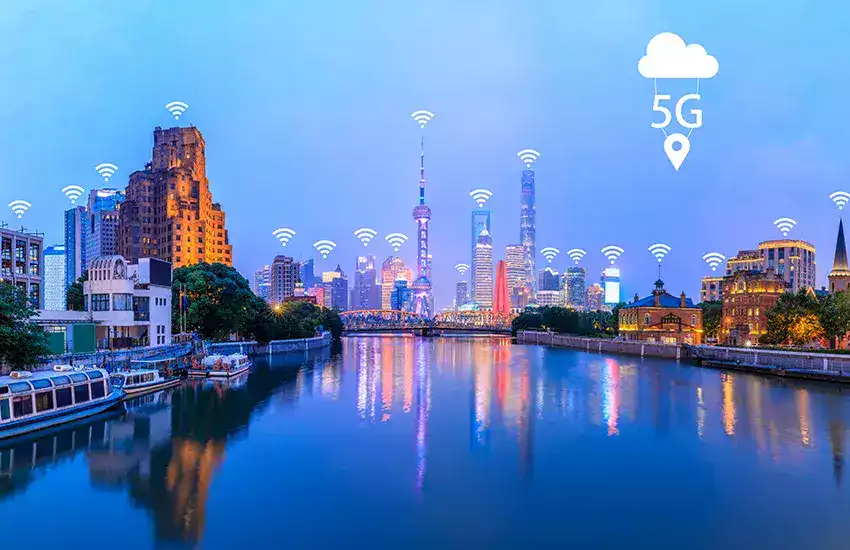
The term “5G” is everywhere. Phone advertisements promise lightning-fast speeds. Telecom companies promote it as revolutionary. News headlines describe it as the future of connectivity.
But what does 5G actually change in your everyday life?
Is it just faster internet on your phone — or something much bigger?
In this in-depth explanation, we’ll break down what 5G really is, how it works, what it improves, and what it means for homes, businesses, smart devices, and the future of digital communication — all in clear American English.
What Is 5G in Simple Terms?
5G stands for “fifth generation” wireless cellular technology.
Every time your phone shows:
3G
4G
LTE
5G
It’s referring to the generation of mobile network technology you’re connected to.
Each generation improves:
Speed
Reliability
Latency (response time)
Capacity
5G is not just an upgrade. It is a major leap in how devices connect and communicate.
How 5G Is Different From 4G
To understand 5G, it helps to compare it to 4G.
4G Capabilities
Good streaming quality
Decent download speeds
Supports mobile apps and video calls
Moderate latency
4G made smartphones powerful.
5G Improvements
Much faster download speeds
Extremely low latency
Ability to connect many more devices simultaneously
More efficient data transmission
5G is designed not only for phones — but for entire digital ecosystems.
What Does “Low Latency” Mean?
Latency is the delay between sending a signal and receiving a response.
For example:
You tap a link.
The server responds.
The page loads.
Lower latency means near-instant reaction.
5G reduces latency dramatically compared to 4G.
This matters for:
Online gaming
Video conferencing
Remote surgery
Autonomous vehicles
Smart city systems
How 5G Actually Works
5G uses radio waves — like previous generations — but with significant technical advancements.
It operates across three main frequency ranges:
Low-Band 5G
Wider coverage
Slower speeds
Better for rural areas
Mid-Band 5G
Balanced speed and coverage
Most common deployment
High-Band 5G (Millimeter Wave)
Extremely fast speeds
Short range
Best in dense urban areas
Higher frequencies carry more data but travel shorter distances.
What Changes in Everyday Phone Use?
For average users, 5G brings:
1. Faster Downloads
Apps install quicker. Videos buffer less.
2. Better Streaming
Higher resolution streaming becomes smoother.
3. More Stable Video Calls
Less freezing or delay during meetings.
4. Improved Cloud Gaming
Games that run on remote servers feel more responsive.
However, the difference may not always feel dramatic for simple tasks like checking email or browsing social media.
5G and Smart Homes
One of the bigger impacts of 5G is in connected devices.
Modern homes include:
Smart thermostats
Security cameras
Smart speakers
Connected appliances
5G supports a massive number of connected devices without congestion.
This improves:
Real-time monitoring
Automation
Reliability
5G and Remote Work
Remote work depends heavily on:
Video conferencing
Cloud applications
File transfers
Real-time collaboration
Lower latency and higher speeds make communication smoother, especially in crowded networks.
5G strengthens mobile work flexibility.
5G and Autonomous Vehicles
Self-driving vehicles require:
Instant communication
Constant data exchange
Real-time mapping updates
5G’s low latency enables near-instant communication between:
Vehicles
Traffic systems
Cloud servers
This is critical for safety.
5G in Healthcare
Healthcare is one of the most transformative areas.
5G enables:
Remote patient monitoring
High-definition telemedicine
Real-time data transmission
Advanced robotic surgery
Doctors can monitor patients remotely with greater precision.
Is 5G Dangerous?
This is a common concern.
5G uses non-ionizing radio waves — similar to previous mobile networks.
Scientific research has not found consistent evidence that 5G causes health problems when operating within regulated safety standards.
Regulatory agencies set exposure limits to ensure public safety.
Why Isn’t 5G Everywhere Yet?
Building 5G infrastructure is expensive and complex.
Challenges include:
Installing new antennas
Upgrading cell towers
Deploying fiber backhaul
Managing spectrum licensing
High-band 5G requires many small cells placed close together.
Urban areas typically receive coverage first.
What Is a “Small Cell”?
Small cells are compact base stations placed on:
Utility poles
Buildings
Streetlights
They improve signal coverage in dense areas.
Because high-frequency 5G signals don’t travel far, small cells are necessary.
5G and Internet of Things (IoT)
The Internet of Things refers to connected devices communicating automatically.
Examples include:
Industrial sensors
Smart agriculture systems
Wearable devices
Traffic management systems
5G can support millions of devices per square mile.
This makes large-scale smart systems possible.
Does 5G Replace WiFi?
No.
5G and WiFi serve different purposes.
WiFi:
Connects devices inside your home
Uses your local internet connection
5G:
Connects mobile devices through cellular networks
Works outside your home
They complement each other.
Can 5G Replace Home Internet?
In some areas, yes.
Fixed Wireless Access (FWA) allows homes to use 5G instead of cable or fiber.
This can provide:
High-speed broadband
Easier installation
Competition for traditional ISPs
However, performance varies by location.
The Environmental Impact of 5G
More infrastructure means higher energy demands.
However:
5G is more energy-efficient per unit of data
Networks are being optimized for sustainability
New hardware reduces power consumption
Long-term efficiency may offset expansion costs.
Why 5G Matters for Artificial Intelligence
AI systems require:
Fast data transfer
Real-time processing
Massive device connectivity
5G enables edge computing — processing data closer to users rather than in distant data centers.
This reduces delay and improves responsiveness.
AI and 5G together accelerate automation.
How to Know If You’re Using 5G
Check your phone display.
It may show:
5G
5G UW (Ultra Wideband)
5G+
Actual speed depends on:
Signal strength
Network congestion
Frequency band
Device compatibility
Not all 5G experiences are equal.
Do You Need a 5G Phone?
If you:
Stream heavily
Play mobile games
Work remotely on mobile networks
Live in strong coverage areas
It may be worth it.
If you mostly use WiFi at home, the upgrade may not feel essential.
The Future of 5G
Future developments include:
Expanded rural coverage
5G integration into smart cities
Enhanced augmented reality
Better emergency response systems
Industrial automation growth
Eventually, 5G will become standard infrastructure, much like 4G today.
Final Thoughts
5G is more than just faster mobile data.
It represents:
Lower latency
Higher capacity
Massive device connectivity
Foundation for smart infrastructure
Support for AI and automation
For daily phone use, the improvements may feel incremental.
But for industries, smart cities, healthcare, transportation, and digital innovation, 5G is transformative.
Understanding what 5G truly changes allows you to see beyond marketing headlines.
It’s not just about speed.
It’s about enabling a connected world where devices communicate instantly, systems operate intelligently, and digital life becomes more seamless than ever before.

0 Comments