


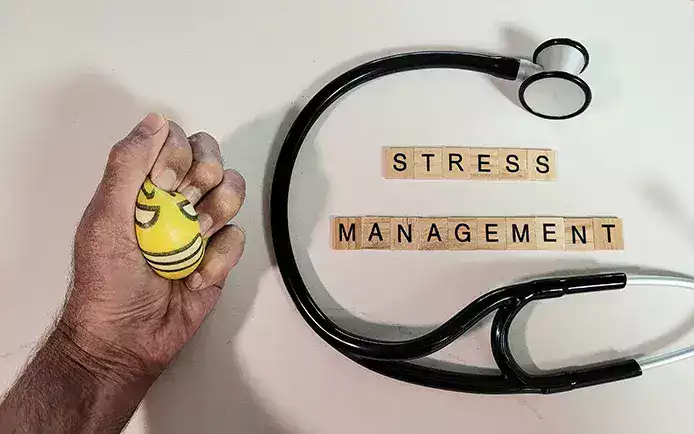
Chronic stress does not always look dramatic. It often appears quietly — as constant tension in the shoulders, difficulty sleeping, irritability over small issues, or mental exhaustion that never fully disappears.
When stress becomes prolonged, it stops feeling temporary and starts shaping identity.
You may begin to believe:
“This is just how life is now.”
“I am always tired.”
“I am constantly overwhelmed.”
“I cannot relax anymore.”
Emotional stability during chronic stress is not about eliminating pressure.
It is about developing powerful internal regulation systems that prevent stress from taking control of your nervous system, your thinking patterns, and your sense of self.
Chronic stress affects more than mood. It alters brain chemistry, increases cortisol levels, disrupts digestion, weakens immunity, and intensifies inflammation.
Over time, unmanaged stress becomes a silent amplifier of physical and emotional symptoms.
The good news is this: emotional stability can be trained.
Understanding the Stress Cycle
When the brain perceives threat — physical or emotional — it activates the sympathetic nervous system.
This is your fight-or-flight response. Heart rate increases. Muscles tighten. Breathing becomes shallow. Cortisol rises.
In short bursts, this system is protective.
But when stress becomes chronic — caregiving pressure, financial strain, health concerns, relationship conflict — the stress cycle does not complete.
The body remains in partial activation mode.
Emotional instability is not weakness. It is physiological overload.
To regain control, you must complete stress cycles intentionally.
Strategy 1: Controlled Nervous System Reset
One of the most powerful emotional stability tools is controlled breathing.
Try this twice daily:
Inhale slowly for four seconds.
Hold for four seconds.
Exhale slowly for six seconds.
Repeat for five minutes.
Longer exhalations activate the parasympathetic nervous system — your body’s calming response.
Consistency is key. Emotional stability grows through repetition, not intensity.
Strategy 2: Cognitive Decompression
Chronic stress fills the mind with repetitive, unresolved thoughts.
Unprocessed thinking creates mental congestion.
Set aside ten minutes daily to write uncensored thoughts. No editing. No filtering. Just release.
Writing reduces mental looping. When thoughts are externalized, they become manageable instead of overwhelming.
This practice prevents emotional accumulation.
Strategy 3: Strategic Energy Boundaries
Emotional instability often stems from overextension.
Ask yourself:
Where am I overcommitting?
Where am I saying yes when I should say no?
What drains me unnecessarily?
Emotional stability requires boundary enforcement.
Powerful boundary statements include:
“I need time to consider that.”
“I cannot commit to that right now.”
“I need to rest before deciding.”
Boundaries protect nervous system integrity.
Strategy 4: Reduce Micro-Stressors
Many people focus only on major stress events. However, micro-stressors compound.
Examples include:
Constant phone notifications
Cluttered environments
Irregular sleep times
Skipped meals
Overexposure to news
Reducing even two or three micro-stressors significantly improves emotional regulation.
Small environmental changes create powerful emotional shifts.
Strategy 5: Sleep Protection as Emotional Armor
Sleep is not optional for stability. It is foundational.
Chronic stress often disrupts sleep through racing thoughts.
To protect sleep:
Avoid screens 30 minutes before bed.
Lower lights gradually.
Create a consistent bedtime.
Keep the bedroom cool and quiet.
Write down worries before lying down.
Restorative sleep strengthens emotional resilience.
Without sleep, emotional reactivity increases dramatically.
Strategy 6: Emotional Labeling
When stress intensifies, people often say “I’m stressed.” But stress contains multiple emotions.
Ask yourself:
Am I frustrated?
Am I afraid?
Am I grieving?
Am I exhausted?
Am I resentful?
Labeling emotions reduces their intensity. Neuroscience shows that naming emotions decreases amygdala activation.
Clarity reduces chaos.
Strategy 7: Physical Stabilization
Emotional stability is not purely psychological.
Stabilize your body through:
Consistent hydration
Balanced nutrition
Gentle movement
Stretching tight muscles
Sunlight exposure
Physical regulation supports emotional regulation.
The body and mind are not separate systems.
Strategy 8: Create Predictability Anchors
Uncertainty fuels stress.
Introduce daily anchors:
Morning routine
Afternoon pause
Evening wind-down ritual
Weekly review session
Predictability creates psychological safety.
When the brain feels safe, emotional intensity decreases.
Strategy 9: Limit Catastrophic Thinking
Chronic stress often activates worst-case scenario thinking.
Challenge thoughts by asking:
What evidence supports this fear?
What evidence contradicts it?
What is a more balanced interpretation?
Cognitive reframing is a powerful emotional stabilization tool.
Strategy 10: Build Resilience Through Micro-Wins
Emotional stability grows when confidence increases.
Each small success — completing a task, managing a conversation calmly, honoring a boundary — builds internal trust.
Track daily micro-wins.
Resilience is cumulative.
The Transformative Power of Consistency
Many people seek dramatic emotional breakthroughs.
But stability is built quietly.
Small, consistent habits outperform intense, short-lived efforts.
If you practice:
Breathing daily
Writing daily
Protecting sleep daily
Setting boundaries consistently
Your nervous system recalibrates over time.
You will notice:
Reduced irritability
Clearer thinking
Improved patience
Deeper sleep
Greater emotional control
A Powerful Perspective Shift
Chronic stress does not mean you are failing.
It means you have been carrying heavy responsibilities without structured recovery.
Emotional stability is not about becoming emotionless.
It is about becoming regulated.
Regulation allows you to experience emotions without being controlled by them.
You are not fragile.
You are overloaded.
And overload can be managed.
With deliberate strategy, powerful boundaries, and consistent nervous system care, emotional stability becomes attainable — even in seasons of prolonged stress.


0 Comments